Alexander of Macedon - Alexander the Great
King of Macedonia and Conqueror of the Persian Empire

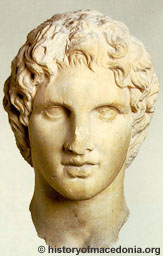 Alexander
III the Great, the King of Macedonia and conqueror of the Persian Empire
is considered one of the greatest military geniuses of all times. He
was inspiration for later conquerors such as Hannibal the
Carthaginian, the Romans Pompey and Caesar, and Napoleon. Alexander was born in 356 BC in Pella, the ancient
capital of Macedonia. He was son of Philip
II, King of Macedonia, and Olympias, the princess of
neighboring Epirus. He spent his childhood watching his father
transforming Macedonia into a great military power, winning victory
after victory on the battlefields throughout the Balkans. When
he was 13, Philip hired the Greek philosopher Aristotle to be
Alexander’s personal tutor. During the next three years
Aristotle gave Alexander a training in rhetoric and literature and
stimulated his interest in science, medicine, and philosophy, all of
which became of importance in Alexander’s later life. In 340,
when Philip assembled a large Macedonian army and invaded Thrace, he
left
his 16 years old son with the power to rule Macedonia in his absence
as regent, which shows that even at such young age Alexander was
recognized as quite capable. But as the Macedonian army
advanced deep into Thrace, the Thracian tribe of Maedi bordering
north-eastern Macedonia rebelled and posed a danger to the
country. Alexander assembled an army, led it against the
rebels, and with swift action defeated the Maedi, captured their
stronghold, and renamed it after himself to Alexandropolis.
Alexander
III the Great, the King of Macedonia and conqueror of the Persian Empire
is considered one of the greatest military geniuses of all times. He
was inspiration for later conquerors such as Hannibal the
Carthaginian, the Romans Pompey and Caesar, and Napoleon. Alexander was born in 356 BC in Pella, the ancient
capital of Macedonia. He was son of Philip
II, King of Macedonia, and Olympias, the princess of
neighboring Epirus. He spent his childhood watching his father
transforming Macedonia into a great military power, winning victory
after victory on the battlefields throughout the Balkans. When
he was 13, Philip hired the Greek philosopher Aristotle to be
Alexander’s personal tutor. During the next three years
Aristotle gave Alexander a training in rhetoric and literature and
stimulated his interest in science, medicine, and philosophy, all of
which became of importance in Alexander’s later life. In 340,
when Philip assembled a large Macedonian army and invaded Thrace, he
left
his 16 years old son with the power to rule Macedonia in his absence
as regent, which shows that even at such young age Alexander was
recognized as quite capable. But as the Macedonian army
advanced deep into Thrace, the Thracian tribe of Maedi bordering
north-eastern Macedonia rebelled and posed a danger to the
country. Alexander assembled an army, led it against the
rebels, and with swift action defeated the Maedi, captured their
stronghold, and renamed it after himself to Alexandropolis.
Two years
later in 338 BC, Philip gave his son a commanding post among the
senior generals as the Macedonian army invaded Greece. At the Battle
of Chaeronea the Greeks were defeated and Alexander displayed his
bravery by destroying the elite Greek force, the Theban Secret Band.
Some ancient historians recorded that the Macedonians won the battle
thanks to his bravery.
The Family Split and the Assassination of Philip II
 But not too long after the defeat
of the Greeks at Chaeronea, the royal family split apart when Philip
married Cleopatra, a Macedonian girl of high nobility. At the wedding
banquet, Cleopatra's uncle, general Attalus, made a remark about
Philip fathering a ‘legitimate’ heir, i.e., one that was of pure
Macedonian blood. Alexander threw his cup at the man, blasting him
for calling him 'bastard child’. Philip stood up, drew his sward,
and charged at Alexander, only to trip and fall on his face in his
drunken stupor at which Alexander shouted:
But not too long after the defeat
of the Greeks at Chaeronea, the royal family split apart when Philip
married Cleopatra, a Macedonian girl of high nobility. At the wedding
banquet, Cleopatra's uncle, general Attalus, made a remark about
Philip fathering a ‘legitimate’ heir, i.e., one that was of pure
Macedonian blood. Alexander threw his cup at the man, blasting him
for calling him 'bastard child’. Philip stood up, drew his sward,
and charged at Alexander, only to trip and fall on his face in his
drunken stupor at which Alexander shouted:
"Here is the man who was making ready to cross from Europe to Asia, and who cannot even cross from one table to another without losing his balance."
 He
then took his mother and fled the country to Epirus. Although allowed
to return later, Alexander remained isolated and insecure at the
Macedonian court. In the spring of 336 BC, with Philip’s Persian
invasion already set in motion, the king was assassinated by a young
Macedonian noble Pausanias, during the wedding ceremony in Aegae,
the old capital
of Macedonia. Why Pausanias killed the Macedonian king is
a question that puzzled both ancient and modern historians. There
is a claim that Pausanias was driven into committing the murder
because he was denied justice by the king when he sought his support
in punishing the Cleopatra's uncle Attalus for earlier mistreatment.
But there are also reports that that both Olympias and Alexander
were responsible for the assassination, by driving the young men
into committing the act. That might explain why Pausanias was instantly
put to death by Alexander's close friends as he attempted to flee
the scene, instead of being captured alive and tried before the Macedonian
assembly. Philip, the
great Macedonian conqueror was dead, the men who liberated his own
country and brought if from the edge of the abyss into a world power.
His dream of conquering the Persian Empire now lays on his successor,
his son king Alexander III.
He
then took his mother and fled the country to Epirus. Although allowed
to return later, Alexander remained isolated and insecure at the
Macedonian court. In the spring of 336 BC, with Philip’s Persian
invasion already set in motion, the king was assassinated by a young
Macedonian noble Pausanias, during the wedding ceremony in Aegae,
the old capital
of Macedonia. Why Pausanias killed the Macedonian king is
a question that puzzled both ancient and modern historians. There
is a claim that Pausanias was driven into committing the murder
because he was denied justice by the king when he sought his support
in punishing the Cleopatra's uncle Attalus for earlier mistreatment.
But there are also reports that that both Olympias and Alexander
were responsible for the assassination, by driving the young men
into committing the act. That might explain why Pausanias was instantly
put to death by Alexander's close friends as he attempted to flee
the scene, instead of being captured alive and tried before the Macedonian
assembly. Philip, the
great Macedonian conqueror was dead, the men who liberated his own
country and brought if from the edge of the abyss into a world power.
His dream of conquering the Persian Empire now lays on his successor,
his son king Alexander III.
Suppression of the Thracian, Illyrian, and Greek Rebellions
Once he ascended on the Macedonian throne, Alexander
quickly disposed of all of his domestic enemies by ordering their
execution. But soon he had to act outside Macedonia.
Philip’s death caused series of rebellions among the conquered
nations and the Illyrians, Thracians, and Greeks saw a chance for
independence. Alexander acted swiftly. He forced his way
into Greece despite the roads leading to the country being blocked
by the Thessalians. As soon as he restored Macedonian rule in
northern Greece, he marched into southern Greece. His speed
surprised the Greeks and by the end of the summer 336 BC they had no
other choice but to acknowledge his authority. But now in Greece, upon rumors of his death, a major
revolt broke out that engulfed the whole nation. Enraged,
Alexander marched south covering 240 miles in two weeks appearing
before the walls of Thebes with large Macedonian army. He let
the Greeks know that it was not too late for them to change their
minds, but the Thebans confident in their position called for all
the Greeks who wished to set Greece free to join them against the
Macedonians. They were not aware that the Athenians and the Peloponnesians,
stunned by the speed of the Macedonian king, quickly reconsidered
their options and were now awaiting the outcome of the battle before
they make their next move. Alexander's general Perdiccas
attacked the gates, broke into the city, and Alexander moved with
the rest of the army behind him to prevent the Thebans from cutting
him off. The Macedonians stormed the city, killing everyone in
sight, women and children included. 6,000 Thebans citizens
died and 30,000 more were sold as slaves. The city where Alexander's
father was kept as hostage for three years, was plundered, sacked,
burned, and razed to the ground, just like Philip acted with Methone,
Olynthus, and the rest of the Greek cities in Chalcidice. Only
the temples and the house of the poet Pindar were spared from
distraction. This was example to the rest of Greece and Athens and
the other Greek city-states quickly rethought their quest for
freedom. Greece remained under Macedonian rule. The Battle of Granicus With
the conquered territories firmly in Macedonian control, Alexander
completed the final preparations for the invasion of Asia. The
22 year-old king appointed Philip's experienced general
Antipater as regent in his absence to preside over the affairs
of Macedonia and Greece, left him a significant force of 13,500
Macedonian soldiers to watch Greece, Thrace, Illyria, and protect
Macedonia, and set out for the Hellespont (modern Dardanelles) in
the spring of 334 BC. As
his ship approached the Asia Minor's coast, he threw his spear from
abroad and stuck it in the ground. He stepped onto the shore, pulled
the weapon from the soil, and declared that the whole of Asia would
be won by the Macedonian spear. In
the army there were 25,000 Macedonians, 7,600 Greeks, and 7,000
Thracians and Illyrians, but the chief officers were all Macedonians,
and Macedonians also commanded the foreign troops. Alexander's
second in command was Philip's general Parmenio, the other important
commanders being Perdiccas, Craterus, Coenus, Meleager,
Antigonus,
and Parmenio's son Philotas. The army soon encountered the forces
of King Darius III. There were 40,000 Persians and Greeks (20,000
each) waiting for them at the crossing of the river Granicus, near
the ancient city of Troy. These Greeks had joined the Persians
in the years following the defeat of the Greek army by Philip II
at Chaeronea. It is important to note the number of Greeks on the
both sides. The Greeks in the Macedonian train were mobilized by
the Macedonians, and historians Peter Green
and Ulrich
Wilcken speak of them as hostages that would ensure the
good behavior of their countrymen left behind in Greece under the
watch of Antipater's Macedonian garrisons. Not surprisingly, the
Greeks in Alexander's army played insignificant role in the upcoming
battles, only to be discharged when convenient. But far greater
number of Greeks joined the Persians brushing away the memory of
the Persian invasion of Greece some 150 years ago. The ancient Greek
historian
Arrian
cited the "old racial rivalry between the Greeks
and Macedonians" that led to this hatred on both sides. The
Macedonians defeated the Persians and put them to flight and although
the Greeks held their ground and fiercely fought, the battle ended
in Macedonian victory. Almost the entire Greek force was annihilated.
18,000 Greeks perished on the banks of Granicus and the 2,000 survivors
were sent to forced labor in Macedonia. The Macedonians lost only
120 men according to tradition. The Campaigns in Asia Minor Alexander
then led the army south across Asia Minor. Ironically, it is not
the Persians but the Greek coastal cities which gave the greatest
resistance to the Macedonians. The Greek commander Memnon and his
men considerably slow down the advance of Alexander and many Macedonians
died during the long and difficult sieges of the Greek cities of
Halicarnassus, Miletus, Mylasa. But at the end the Macedonian army
defeated the enemy and conquered the coast of Asia Minor. Alexander
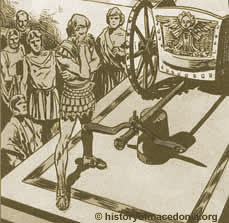
then turned northward to central Asia Minor, to the city of Gordium. Gordium
was a home of the famous so-called Gordian Knot. Alexander knew
the legend that said that the man who could untie the ancient knot
was destined to rule the entire world. To that date nobody had succeeded
in raveling the knot. But the young Macedonian king simply slashed
it with his sword and unraveling its ends. The Battle of Issus "Riding to the front line he (Alexander the Great) named the soldiers
and they responded from spot to spot where they were lined up. The
Macedonians, who had won so many battles in Europe and set off to
invade Asia ... got encouragement from him - he reminded them of
their permanent values. They were the world's liberators and one
day they would pass the frontiers set by Hercules and Father Liber.
They would subdue all races on Earth. Bactria and India would become
Macedonian provinces. Getting closer to the Greeks, he reminded
them that those were the people (the Persians on the other side)
who provoked war with Greece, ... those were the people that burned
their temples and cities ... As the Illyrians and Thracians lived
mainly from plunder, he told them to look at the enemy line glittering
in gold ..."
(Q. Curtius Rufus 3.10.4-10)
Darius's
army greatly outnumbered the Macedonians, but the Battle of Issus
ended in a big victory for Alexander. Ten's of thousands of Persians,
Greeks, and other Asiatic soldiers were killed and king Darius fled
in panic before the Macedonian phalanx, abandoning his mother, wife,
and children behind. Alexander treated them with the respect out
of consideration for their royalty. The Sieges of Tyre and Gaza The
victory at Issus opened the road for Syria and Phoenicia. In early
332, Alexander sent general Parmenio to occupy the Syrian cities
and himself marched down the Phoenician coast where he received
the surrender of all major cities except the island city of Tyre
which refused to grant him access to sacrifice at the temple of
the native Phoenician god Melcart. A very difficult seven-month
siege of the city followed. In an enormous effort, the Macedonians
begun building a mole that would connect the island-city with the
coast. Tons of rocks and wood were poured into the water strip
separating the island from the coast but its construction and the
attacks from the city walls cost Alexander many of his bravest Macedonians.
Although seriously tempted to lift the siege and continue marching
on Egypt, Alexander did not abandon the project and continued the
siege, surrounding the island with ships and blasting the city walls
with catapults. When the walls finally gave in, the Macedonians
poured their anger over the city defenders - 7,000 people were killed,
30,000 were sold as slaves. Alexander entered the
temple of Melcart, and had his sacrifice. During
the seven-month siege of Tyre, Alexander received a letter from
Darius offering a truce with a gift of several western provinces
of the Persian Empire, but he refused to make peace unless he could
have the whole empire. He continued marching south toward Egypt
but was again held up by resistance at Gaza. The Macedonians put
the city under a siege which lasted two months, after which the
scenario of Tyre was repeated. With the fall of Gaza, the whole
Eastern Mediterranean coast was now secured and firmly in the hands
of the Macedonians. The
mainland Greeks had hoped that the Persian navy and the Greek commander
Memnon would land in Greece and help them launch a rebellion against
Antipater's Macedonians, transfer the war into Macedonia itself,
and cut off Alexander in Asia, but the sealing of the coast prevented
this from happening. Memnon fell sick and died while attempting
to regain the lost Greek city of Miletus on the Asia Minor coast,
and the Persian plan to transfer the war into Europe well apart. Alexander in Egypt In
the spring of 331 Alexander made a pilgrimage to the great temple
and oracle of Amon-Ra, the Egyptian god of the sun, whom the Greeks
and Macedonians identified with Zeus Ammon. The earlier Egyptian
pharaohs were believed to be sons of Amon-Ra and Alexander as new
ruler of Egypt wanted the god to acknowledge him as his son. He
decided to make the dangerous trip across the desert to visit the
oracle at the temple of the god. According to the legend, on the
way he was blessed with abundant rain, and guided across the desert
by ravens. At the temple, he was welcomed by the priests and spoke
to the oracle. The priest told him that he was a son of Zeus Ammon,
destined to rule the world, and this must have confirmed in him
his belief of divine origin. Alexander remained in Egypt until
the middle of 331, and then returned to Tyre before facing Darius. The Battle of Gaugamela At
Tyre, Alexander received reinforcements from Europe, reorganized
his forces, and started for Babylon. He conquered the lands between
rivers Tigris and Euphrates and found the Persian army at the plains
of Gaugamela, near modern Irbil in Iraq, which according to the
exaggerated accounts of antiquity was said to number a million men.
The Macedonians spotted the lights from the Persian campfires and
encouraged Alexander to lead his attack under cover of darkness.
But he refused to take advantage of the situation because he wanted
to defeat Darius in an equally matched battle so that the Persian
king would never again dare to raise an army against him. The
two armies met on the battlefield the next morning, October 1, 331
BC. On the Persian side were numerous Asiatic nations - Bactrians,
Indians, Medians, Sogdians, even Albanians from the Caucasus, the
ancestors of the modern Albanians who many centuries later migrated
to Europe and are now northern neighbors to the modern Greeks and
western neighbors to the modern Macedonians. The survivors of the
50,000 Greeks which Darius had on his side at the beginning of the
war were also among the Persian ranks.
At
the beginning of the battle the Persian forces split and separated
the two Macedonians wings. The wing of general Parmenio appeared to
be backing down, but Alexander's cavalry rode straight after Darius
and forced again his flight like he did at Issus. Darius fled to
Ecbatana in Media, and Alexander occupied Babylon, the imperial
capital Susa, and the Persian capital Persepolis, and was henceforth
proclaimed king of Asia. Four months later, the Macedonians burned
the royal palace in Persepolis, completing the end of the ancient
Persian Empire. Suppression of the Greek Rebellion, Discharge of the Greeks,
and the Death of Darius Meanwhile
in Greece, the Greeks under the leadership of Sparta rose to a rebellion
against the Macedonian occupation.
Antipater was in Thrace at the time
and the Greeks took the opportunity to push back the Macedonian
forces. But their initial victory did not last for long as Antipater
returned with a large army, defeated the rebels, and regained Greece.
5,300 Greeks, including the Spartan king Agis were killed, while
the Macedonians lost 3,500 men. In
Asia, the news of the beginning of the Greek rebellion had Alexander
so deeply worried, that he immediately sent money to Antipater to
counter it. And when he learned that the Greeks were defeated,
he proclaimed the end of the "Hellenic Crusade" and discharged
all-Greek forces in his army. He no longer needed these hostages
and potential troublemakers. Alexander
continued his pursuit of Darius for hundreds of miles from Persepolis.
When he finally caught up to him, he found the Persian king dead
in his coach. He was assassinated by Bessus, the satrap of Bactria
which now proclaimed himself "King of the Kings",
assuming the
title of the Persian kings. Alexander gave Darius a royal funeral
and set out for Bactria after his murderer. The
Trial of Philotas and the Murder of Parmenio But
the Macedonians were unhappy with Alexander's Orientalization for
they were proud of their Macedonian customs, culture, and language.
His increasingly Oriental behavior eventually led to conflict with
the Macedonian nobles and some Greeks in the train. In 330 BC series
of allegations were brought up against some of Alexander's officers
concerning a plot to murder him. Alexander tortured and executed
the accused leader of the conspiracy, Parmenio's son Philotas, the
commander of the cavalry. Several other officers were also executed
according to Macedonian law, in order to eliminate the alleged attempt
on Alexander's life. During the trial of Philotas Alexander raised
the question of the use of the ancient Macedonian language. He spoke:
"'The Macedonians are about to pass judgment upon you; I wish
to know whether you will use their native tongue in addressing
them.' Philotas replied: 'Besides the Macedonians there are many present who, I think, will
more easily understand what I shall say if I use the same language
which you have employed.' Than said the king: 'Do you not see how Philotas loathes even the language of his fatherland?
For he alone disdains to learn it. But let him by all means speak
in whatever way he desires, provided that you remember that he
holds out customs in as much abhorrence as our language.'"
(Quintus Curtius Rufus 6.9.34-36) The
trial of Philotas took place in Asia before a multiethnic public,
which has accepted Greek as their common language. Alexander spoke
Macedonian with his conationals, but used Greek in addressing the
Greeks and the Asians, as Greek was widely taken as international
language in ancient times. Like Carthaginian, Illyrian, and Thracian, ancient Macedonian was not
recorded in writing. However, on the bases of about hundred glosses,
Macedonian words noted and explained by Greek writers, some place
names from Macedonia, and names of individuals, most scholars
believe that ancient Macedonian was a separate Indo-European language.
Evidence from phonology indicates that the ancient Macedonian language
was distinct from ancient Greek and closer to the Thracian and Illyrian
languages. Some modern writers have erroneously concluded that the
Macedonians spoke Greek based on few Greek inscriptions discovered
in Macedonia, but that is by no means a proof that the Macedonian
was not a distinct language. Greek inscriptions were also found
in Thrace and Illyria, the Thracians even inscribed their coins and vessels
in Greek, and we know that both the Illyrians and the Thracians
were not Greeks who had distinct languages. After
Philotas was executed according to the Macedonian custom, Alexander
ordered next the execution of Philotas' father, general Parmenio.
But the death of the old general did not sit well with every Macedonian
in the army. Parmenio was a veteran, proven solder of Philip's
guard, a men who played a major part in leading the Macedonian armies
and rising the country to a world power. In fact Philip II had often
remarked how proud he was to have Parmenio as his general. The Murder of Cleitus and the execution of Callisthenes Alexander
next killed Cleitus, another Macedonian noble, in a drunken brawl.
Heavy drinking was a cherished tradition at the Macedonian court
and that day Cleitus publicly denounced the king before the present
for the murders of Parmenio and Philotas. He went further by ridiculing
Alexander for claiming to be "son of Ammon" and for denouncing
his own father Philip II. Alexander lost his temper, snatched the
spear from the bodyguard standing near, and ran Cleitus through
with it. Although he mourned his friend excessively and nearly committed
suicide when he realized what he had done, all of Alexander's associates
thereafter feared his paranoia and dangerous temper. He
next demanded that Europeans, just like the Asians, follow the Oriental
etiquette of prostrating themselves before the king - which he knew
was regarded as an act of worship by the Greeks. But resistance
put by Macedonian officers and by the Greek historian Callisthenes,
the nephew of Aristotle who had joined the expedition, defeated
the attempt. Callisthenes was soon executed on a charge of conspiracy,
and we can only imagine how Aristotle received the news of his death.
The two were already estranged for a long time before Callisthenes’
execution, as Alexander's letters to his former tutor carried unfriendly
contents. The
Macedonians spent two hard years in Bactria fighting a guerilla
war against the followers of Bessus and the Sogdian ruler Spitamenes.
Finally, Bessus was caught and executed for the murder of his king
Darius III, and Spitamenes was killed by his own wife which was
tired of running away. Bactria and Sogdiana, the most eastern provinces
of the Persian Empire came under Macedonian control. It is here
that Alexander fell in love with and married the beautiful Sogdian
princess Roxane. The March on India The
army continued advancing as far as the river Hydaspes but at this
point the Macedonians refused to go farther as reports were coming
of far more larger and dangerous armies ahead equipped with many
elephants and chariots. General Coenus spoke on army's behalf to
the king. Reluctantly, Alexander agreed to stop here. Not too
long afterwards Coenus died and the army buried him with the highest
honors. It
was agreed that the army travel down south the rivers Hydaspes and
Indus so that they might reach the Ocean on the southern edge of
the world and from there head westward toward Persia. 1,000 ships
were constructed and while the navy sailed the rivers, the army
rode down along the rivers banks, stopping to attack and subdue
the Indian villages along the way. One
of the villages in which the army stopped belonged to the Malli,
who were said to be one of the most warlike of the Indian tribes.
Alexander was severally wounded in this attack when an arrow pierced
his breastplate and his ribcage. The Macedonians rescued him
in a narrow escape from the village. Still the Malli surrendered
as Alexander became to recover from the grave wound. The travel
down the river resumed and the Macedonian army reached the mouth
of the Indus in the summer of 325 BC. Then it turned westward to
Persia. But
the return was a disaster. The army was marching through the notorious
Gerdosian desert during the middle of the summer. By the time Alexander
reached Susa thousands had died of heat and exhaustion. Alexander's Death In the spring of 324, Alexander
held a great victory celebration at Susa. He and 80 of his close
associates married Persian noblewomen. In addition, he legitimized
previous so-called marriages between soldiers and native women and
gave them rich wedding gifts, no doubt to encourage such unions.
But
Alexander will never see this happen. Shortly before beginning
of the planned Arabian campaign, he contracted a high fever after
attending a private party at his friend's Medius of Larisa. As
soon as he drank from the cup he “shrieked aloud as if smitten by
a violent blow”. The fever became stronger with each following day
to the point that he was unable to move and speak. The Macedonians
were allowed to file past their leader for the last time before
he finally succumbed to the illness on June 7, 323 BC in the Macedonian
month of Daesius. Alexander the Great, the Macedonian king and the
great conqueror of Persian Empire, died at the age of 33 without
designating a successor to the Macedonian Empire. After Alexander After
his death, nearly all the noble Susa marriages dissolved, which
shows that the Macedonians despised the idea. There never came to
unity between Macedonians and Persians and there wasn't even a unity
among the Macedonians. Alexander's death opened the anarchic age
of the Successors and a bloody Macedonian civil war for power
followed. As
soon as the news of Alexander's death were known, the Greeks rebelled
yet again and so begun the Lamian War. The Macedonians were defeated and expelled from
Greece, but then Antipater received reinforcements from
Craterus who brought to Macedonia the 10,000 veterans discharged
at Opis. Antipater and Craterus jointly marched into Greece, defeated
the Greek army at Crannon in Thessaly and brought the war to an
end. Greece will remain under Macedonian rule for the next one and
a half century. In
Asia the Macedonian commanders who served Alexander fought each
other for power. Perdiccas and Meleager were murdered, Antigonus rose to control most of Asia, but his growth of
power brought the other Macedonian generals in coalition against
him. He was killed in battle and the Macedonian Empire split into
four main kingdoms - the one of
Seleucus (Asia), Ptolemy (Egypt), Lysimachus (Thrace), and Antipater's son
Cassander (Macedonia, including Greece). With
the split of the Roman Empire into Western and Eastern (Byzantium),
the Macedonians came to play a major role in Byzantium. The period
of rule of the
Macedonian dynasty which ruled the
Eastern Roman Empire from 867 to 1056 is known as the "Golden Age" of the Empire. The Eastern Roman Empire
fell in the 15th century and Macedonia, Greece, and the
whole southern Balkans came under the rule of the Turkish Empire.
Greece
gained its independence at the beginning of the 19th
century with the help of the Western European powers, while Macedonia which continued to be occupied
by foreign powers, gained independence in 1991, but only over 37%
of its historical ethnic territory. With the Balkan Wars of 1912/13 Macedonia was
occupied by the armies of its neighbors - 51% of it's territory came under, and still is under the rule of Greece, while the remaining
12% are still occupied by Bulgaria. Both Greece and Bulgaria had
been condemned numerous times for the oppression of their large Macedonian minorities
which they had stripped off basic human rights, ever since the partition
of the country. (bibliography Ancient Greek and Roman Historians
and Modern Historians) copyright © 2001-2003
alexanderofmacedon.org a
project of historyofmacedonia.org
all rights reserved Believing
the Greece would remain calm, Alexander returned to Macedonian,
marched east into Thrace, and campaigned as far as the Danube
river. He defeated the Thracians and Tribalians in series of
battles and drove the rebels beyond the river. Then he marched back
across Macedonia and on his return crushed in a single week the
threatening Illyrians, before they could receive additional
reinforcements.
Believing
the Greece would remain calm, Alexander returned to Macedonian,
marched east into Thrace, and campaigned as far as the Danube
river. He defeated the Thracians and Tribalians in series of
battles and drove the rebels beyond the river. Then he marched back
across Macedonia and on his return crushed in a single week the
threatening Illyrians, before they could receive additional
reinforcements.


 In
the autumn of 333 BC, the Macedonian army's encountered the Persian
forces under the command of King Darius III himself at a mountain
pass at Issus in northwestern Syria. 30,000 Greeks again formed
a sizable addition to the Darius' army as elite fighters and were
positioned directly against the Macedonian phalanx. Describing the
atmosphere before a battle, the Roman historian Curtius explained
how Alexander raised the morale of the Macedonians, Greeks, Illyrians,
and Thracians in his army, one at the time:
In
the autumn of 333 BC, the Macedonian army's encountered the Persian
forces under the command of King Darius III himself at a mountain
pass at Issus in northwestern Syria. 30,000 Greeks again formed
a sizable addition to the Darius' army as elite fighters and were
positioned directly against the Macedonian phalanx. Describing the
atmosphere before a battle, the Roman historian Curtius explained
how Alexander raised the morale of the Macedonians, Greeks, Illyrians,
and Thracians in his army, one at the time:
 Alexander entered Egypt in the beginning
of 331 BC. The Persian satrap surrendered and the Macedonians were
welcomed by the Egyptians as liberators for they had despised living
under Persian rule for almost two centuries. Here Alexander ordered
that a city be designed and founded in his name at the mouth of
river Nile, as trading and military Macedonian outpost, the first
of many to come. He never lived to see it built, but Alexandria
will become a major economic and cultural center in the Mediterranean
world not only during the Macedonian rule in Egypt but centuries
after.
Alexander entered Egypt in the beginning
of 331 BC. The Persian satrap surrendered and the Macedonians were
welcomed by the Egyptians as liberators for they had despised living
under Persian rule for almost two centuries. Here Alexander ordered
that a city be designed and founded in his name at the mouth of
river Nile, as trading and military Macedonian outpost, the first
of many to come. He never lived to see it built, but Alexandria
will become a major economic and cultural center in the Mediterranean
world not only during the Macedonian rule in Egypt but centuries
after. 


To win the support of the Persian aristocracy Alexander appointed
many Persians as provincial governors in his new empire. He adopted
the Persian dress for ceremonies, gave orders for Persians to be
enlisted in the army, and encouraged the Macedonians to marry Persian
women.
 In the spring of 327 BC, Alexander and his army marched into India
invading Punjab. The greatest of Alexander's battles in India was
at the river Hydaspes, against king Porus, one of the most powerful
Indian rulers. In the summer of 326 BC, Alexander's army crossed
the heavily defended river during a violent
thunderstorm to meet Porus' forces. The Indians were defeated in
a fierce battle, even though they fought with elephants, which the
Macedonians had never seen before. Porus was captured and like the
other local rulers he had defeated, Alexander allowed him to continue
to govern his territory.
In the spring of 327 BC, Alexander and his army marched into India
invading Punjab. The greatest of Alexander's battles in India was
at the river Hydaspes, against king Porus, one of the most powerful
Indian rulers. In the summer of 326 BC, Alexander's army crossed
the heavily defended river during a violent
thunderstorm to meet Porus' forces. The Indians were defeated in
a fierce battle, even though they fought with elephants, which the
Macedonians had never seen before. Porus was captured and like the
other local rulers he had defeated, Alexander allowed him to continue
to govern his territory.  In this battle
Alexander's horse Bucephalus was wounded and died. Alexander had
ridden Bucephalus into every one of his battles in Europe and Asia,
so when it died he was grief-stricken. He founded a city which
he named Buckephalia, in his horse's name.
In this battle
Alexander's horse Bucephalus was wounded and died. Alexander had
ridden Bucephalus into every one of his battles in Europe and Asia,
so when it died he was grief-stricken. He founded a city which
he named Buckephalia, in his horse's name.

 Little
later, at Opis he proclaimed the discharge of 10,000 Macedonian
veterans to be sent home to Macedonia with general
Craterus. Craterus' orders were to
replace Antipater and Antipater’s to bring new reinforcements in
Asia. But the army mutinied hearing this. Enraged Alexander pointed
the main ringleaders to his bodyguards to be punished and then gave
his famous speech where he reminded the Macedonians that without
him and his father Philip, they would have still been leaving in
fear of the nations surrounding Macedonia, instead of ruling
the world. After this the Macedonians were reconciled with their
king and 10,000 of them set out for Europe, leaving their children
of Asian women with Alexander. In the same time 30,000 Persian youth
already trained in Macedonian manner were recruited in the army.
Alexander prayed for unity between Macedonians and Persians and
by breeding a new army of mixed blood he hoped to create a core
of a new royal army which would be attached only to him.
Little
later, at Opis he proclaimed the discharge of 10,000 Macedonian
veterans to be sent home to Macedonia with general
Craterus. Craterus' orders were to
replace Antipater and Antipater’s to bring new reinforcements in
Asia. But the army mutinied hearing this. Enraged Alexander pointed
the main ringleaders to his bodyguards to be punished and then gave
his famous speech where he reminded the Macedonians that without
him and his father Philip, they would have still been leaving in
fear of the nations surrounding Macedonia, instead of ruling
the world. After this the Macedonians were reconciled with their
king and 10,000 of them set out for Europe, leaving their children
of Asian women with Alexander. In the same time 30,000 Persian youth
already trained in Macedonian manner were recruited in the army.
Alexander prayed for unity between Macedonians and Persians and
by breeding a new army of mixed blood he hoped to create a core
of a new royal army which would be attached only to him. 
 The
rise of Rome put an end to Macedonian kingdoms. Macedonia and Greece
were conquered in 167/145 BC, Seleucid Asia by 65 BC, and Cleopatra VII, the last Macedonian descendent of Ptolemy committed
suicide in 30 BC, after which Egypt was added to the Roman Empire.
The
rise of Rome put an end to Macedonian kingdoms. Macedonia and Greece
were conquered in 167/145 BC, Seleucid Asia by 65 BC, and Cleopatra VII, the last Macedonian descendent of Ptolemy committed
suicide in 30 BC, after which Egypt was added to the Roman Empire.
terms
of service
feedback: feedback@historyofmacedonia.org



Alexander
III the Great - King of Macedonia
History
of the Macedonian Kingdom in Asia
History
of the Macedonian Kingdom in Egypt
Timeline
of the History of Macedonia
Ancient
Quotes on the Macedonians as Distinct Nation
Modern
Historians on the Macedonians as Distinct Nation
Greeks
and Macedonians
Ernst Badian
(Harvard University)
Why
Macedonia and the Macedonians had never been Greek?
Similarities
Between Ancient Macedonian and Today's Macedonian Culture
Differences
Between the Ancient Macedonians and the Ancient Greeks by J.S.
Gandeto
Why
were the Macedonians styled as "Greeks" in the 19th Century?
Why
is Greece Stealing the Macedonian History?
The
Distortions of Modern Western and Greek historians
Map
depicting the partition of Macedonia by Greece, Bulgaria, Serbia, and
Albania in 1913
The
Balkan Wars and the Partition of Macedonia
The
King of the Greeks on the Greek Occupation of Macedonia
Map
of Aegean Macedonia showing the areas where Macedonians live
Human
Rights Watch International Condemns Greece for Oppressing the Macedonians
Quotes from the ancient and modern historians
"The fight was further embittered by the old racial rivalry of Greek and Macedonian" - Arrian
"When oaths to this effect had been sworn and the Greeks were interspersed among the Macedonians, Pithon was greatly pleased, seeing that the affair was progressing according to his intentions; but the Macedonians remembering the orders of Perdiccas and having no regard for the oaths that had been sworn, broke faith with the Greeks. Setting upon them unexpectedly and catching them off their ground, they shot them all down with javelins and seized their possessions as plunder. Pithon then, cheated of his hopes, came back with the Macedonians to Perdiccas" - Diodorus 18.7.8-9
"The Macedonian army, which will have the exclusive status, was to be supported by the Greek army and by the armies of the adjacent conquered nations" - Justin 9.5.5-8.
"Antipater was appointed governor of Macedonia and Greece" - Justin 13.4.5
"His Majesty Alexander to Darius: Greetings. The Darius whose name you have assumed wrought utter destruction upon the Greek inhabitants of the Hellespontine coast and upon the Greek colonies of Ionia, and then crossed the sea with a mighty army, bringing the war to Macedonia and Greece" - Curtius
"Neither Greeks nor Macedonians considered the Macedonians to be Greeks." Borza
"The conclusion is inescapable: there was a largely ethnic Macedonian imperial administration from beginning to end. Alexander used Greeks in court for cultural reasons, Greek troops (often under Macedonian commanders) for limited tasks and with some discomfort, and Greek commanders and officals for limited duties. Typically, a Greek will enter Alexander's service from an Aegean or Asian city through the practice of some special activity: he could read and write, keep figures or sail, all of which skills the Macedonians required. Some Greeks may have moved on to military service as well. In other words, the role of Greeks in Alexander's service was not much different from what their role had been in the services of Xerxes and the third Darius." Borza
"If one wishes to believe that Alexander had a policy of hellenization - as opposed to the incidental and informal spread of Greek culture - the evidence must come from sources other than those presented here. One wonders - archeology aside - where this evidence would be." Borza
On the ethnic tension between Macedonians and Greeks, referring to the episode of Eumenes of Cardia and his bid to reach the throne: "And if there were any doubt about the status of Greeks among the Macedonians the tragic career of Eumenes in the immediate Wars of succession should put it to rest. The ancient sources are replete with information about the ethnic prejudice Eumenes suffered from Macedonians."
Borza
"The tension at court between Greeks and Macedonians, tension that the ancient authors clearly recognized as ethnic division." Borza
"The main evidence for Macedonian existing as separate language comes from a handful of late sources describing events in the train of Alexander the Great, where the Macedonian tongue is mentioned specifically." Borza
"Greeks and Macedonians remained steadfastly antipathetic toward one another (with dislike of a different quality than the mutual long-term hostility shared by some Greek city-states) until well into the Hellenic period, when both the culmination of hellenic acculturation in the north and the rise of Rome made it clear that what these peoples shared took precedence over their historical enmities." Borza
"They made their mark not as a tribe of Greek or other Balkan peoples, but as 'Macedonians'. This was understood by foreign protagonists from the time of Darius and Xerxes to the age of Roman generals." Borza
"What did others say about Macedonians? Here there is a relative abundance of information", writes Borza, "from Arrian, Plutarch (Alexander, Eumenes), Diodorus 17-20, Justin, Curtius Rufus, and Nepos (Eumenes), based upon Greek and Greek-derived Latin sources. It is clear that over a five-century span of writing in two languages representing a variety of historiographical and philosophical positions the ancient writers regarded the Greeks and the Macedonians as two separate and distinct peoples whose relationship was marked by considerable antipathy, if not outright hostility." Borza
"The suggestion is surely that Macedonian was the language of the infantry and that the Greek was a difficult indeed a foreign tongue to them". Badian
"Alexander never tried to impose Greek on his Macedonian infantry, or to integrate it with Greek 'foreign' individuals". Badian
"Philip had not tried to pass of his Macedonians as Greeks" Badian
"The Colonels, as it happened, promoted Alexander as a great Greek hero, especially to army recruits: the Greeks of the fourth century B.C., to whom Alexander was a half-Macedonian, half-Epirote barbarian conqueror, would have found this metamorphosis as ironic as I did." Green
"Macedonia was the first large territorial state with an effective centralized political, military and administrative structure to come into being on the continent of Europe". Green
"And though Philip did not give a fig for Panhellenism as an idea, he at once saw how it could be turned into highly effective camouflage ( a notion which his son subsequently took over ready-made). Isocrates had, unwittingly, supplied him with the propaganda-line he needed. From now on he merely had to clothe his Macedonian ambitions in a suitable Panhellenic dress." Green
"The Greek states retained no more than a pale shadow of their former freedom". Green
"The Greek states were to make a common peace and alliance with one another, and constitute themselves into a federal Hellenic League. Simultaneously, the league was to form a separate alliance with Macedonia, though Macedonia itself would not be a league member." Green
"Philip’s Panhellenism was no more than a convenient placebo to keep his allies quiet, a cloak for further Macedonian aggrandizement." Green
"Most Greek statesmen recognized this only too well. To them, their self-styled hegemon was still a semi-barbarian autocrat, whose wishes had been imposed on them by right of conquest; and when Alexander succeeded Philip, he inherited the same bitter legacy of hatred and resentment - which his own policies did little to dispel." Green
"In the early spring of 336, an advance force of 10,000 men, including a thousand cavalry, crossed over to Asia Minor. Its task was to secure the Hellespont, to stockpile supplies, and in Philip’s pleasantly cynical phrase, to ‘liberate the Greek cities’." Green
"This was the Panhellenic crusade preached by Isocrates, and as such the king’s propaganda section continued - for the time being - to present it. No one, so far as we know, was tactless enough to ask the obvious question: if this was a Panhellenic crusade, where were the Greek troops?" Green
"The truth of the matter seems to have been that Alexander distrusted his Greek allies so profoundly - and with good reason - that he preferred to risk the collapse of his campaign in a spate of rebellion rather than entrust its safety to a Greek fleet." Green
"But then, Eumenes was a Greek, and Macedonian troops, especially the old sweats who had served under Philip II, were never really comfortable being led by non-Macedonians." Green
"I deliberately refrain from adopting any position on the linguistic status of ancient Macedonian. It has little significance outside the nationalistic propaganda of the contemporary Balkan states, in which prejudice and dogma do duty for rational thought. What matters for the present argument is the fact, explicit in Curtius, that Macedonian was largely unintelligible to non-Macedonians. Macedonians might understand Greek, and some Greek (like Eumenes) with experience of Macedon might speak Macedonian. However, even Eumenes took care that a vital message was conveyed to the phalangites of Neoptolemus by a man fluent in Macedonian (MAKEDONI/ZONTA TH]=FWNH]=:PSI 12. 1284,col. ii. 19-20).] "Alexander shouted out in Macedonian, and called the hypaspists in Macedonian." In my view there is nothing at all surprising in the use of Macedonian. Alexander was calling his hypaspists, who were Macedonians, and he addressed them in their native language/dialect." Bosworth
"The Macedonians themselves were not Hellenes; they belonged to the barbaric races, not greatly differing from the Greeks in ethnic type, but far behind them in civilization, which bordered Hellas upon the north. They were a distinct race, not Paeonian, not Illyrian, not Thracian; but, of the three, their connection was closest with the Illyrians." Rawlinson
"It is thus not surprising that the Macedonians considered themselves to be, and were treated by Alexander the Great as being, separate from the Greeks. They were proud to be so." Hammond
"He knew from experience that in the eyes of the Macedonians he was still a Greek, a foreigner. Plutarch praised his charming and refined manners, which were very unlike the haughty airs of the noble Macedonian officer." Jouguet
"The dislike was reciprocal, for the Macedonians have grown into a proud masterful nation, which with highly developed national consciousness looked down upon the Hellenes with contempt. This fact too is of prime importance for the understanding of later history." Wilcken
"Philip II of Macedonia (359-336), who made his country into a major power, virtually controlling the mainland Greek city-states, intended to lead his and their forces against the two-centuries-old Persian (Achaemenid) empire, which ruled over huge territories extending from the Aegean to Egypt and central Asia. Philip's motives were mixed: revenge for the Persian invasion of Macedonia and Greece in the previous century, annoyance because the contemporary Persians had at times aided the king's own Greek opponents, a desire to wipe out the only large-scale potential enemy to the Macedonians that was still in existence - and pure lust for expansion." Grant
"In 334 BC, at the head of 40,000 Macedonian and Greek troops, he (Alexander) crossed the Hellespont (Dardanelles) and confronted the Persian advanced forces on the river Granicus (Can Cayi), winning a victory which enabled him to conquer western and southern Asia Minor." Grant
"Reading the lesson of his times, and making the proved inferiority of citizen militia to standing forces, and of the capricious rule of the many to an imperial system under a single head, he evolved the first European Power in the modern sense of the word-- an armed nation with a common national ideal. This, his own conception, he understood clearly and perused consistently through twenty-three years. Surely such a man may be called great for what he was." Hogarth
"Isocrates had long been urging the Greeks to combine in a war of conquest against Persia, and had latterly incited Philip to lead the enterprise. But Isocrates evinced little concern for the ' enslavement ' of the Asian Greeks or desire to revenge the atrocities of the Persians in 480-479.62 In his conception a Panhellenic crusade would promote peace at home and provide the Greeks with new lands on which to settle their surplus population; Philip was to be content with the glory of benefiting the Greeks by victories over the barbarians.63 If we can believe the ' vulgate ', Callisthenes may well have shared this na1ve idea, for we are told that he reminded Alexander of his original purpose, to annex ' Asia' to Greece (iv 11, 7). It is quite unlikely that either Philip or Alexander ever entertained such a purpose. They could allege Macedonian casus belli: in the fifth century the Persians had invaded Macedon as well as Greece, and in 340 they had helped Perinthus to repel Philip's attack; Alexander even had the impudence to add that Darius had been guilty of hostile acts against him-after Philip had already invaded Asia (ii 14, 4 f.). But all these were surely pretexts. Conquest must have been the real purpose." Brunt
"Macedonian and Greek were mutually unintelligible in the court of Alexander the Great" R.A.Crossland